In calm, ranging markets, a martingale forex robot looks like the best system you have ever run. Win rate above 90%. Smooth equity curve trending upward. Drawdown barely visible on the chart. Then a single news event hits, and the account that took months to build loses 60% in 48 hours.
This is not hypothetical. It is what happens to martingale EAs during the kind of macro-driven price moves that have become routine in 2026. Understanding why and knowing which EAs are genuinely built without martingale logic is now a prerequisite for anyone running automated trading systems with real capital.
What Is the Martingale Strategy And Example
Martingale is simple in principle: double your position size after every loss, so when you eventually win, you recover all previous losses plus a small profit. It comes from 18th-century casino gambling and was designed for games with near-50/50 odds and no position limits.
Applied to forex, it works like this:
| Trade | Lot Size | Direction | Result | Cumulative Loss |
|---|---|---|---|---|
| 1 | 0.01 | BUY Gold at $4,700 | SL hit at $4,680 → -$2 | -$2 |
| 2 | 0.02 | BUY Gold at $4,680 | SL hit at $4,660 → -$4 | -$6 |
| 3 | 0.04 | BUY Gold at $4,660 | SL hit at $4,640 → -$8 | -$14 |
| 4 | 0.08 | BUY Gold at $4,640 | SL hit at $4,620 → -$16 | -$30 |
| 5 | 0.16 | BUY Gold at $4,620 | Gold bounces → +$32 | Net: +$2 |
When gold reverses on Trade 5, all losses recover and the system books a $2 net profit. On paper, this always works — as long as gold eventually bounces and the account has enough margin to hold through all the intermediate losses.
The problem: gold in 2026 has moved from $3,100 to an all-time high of $5,417 in January, a $2,300 directional move without meaningful reversal. An EA running a martingale buy sequence during that kind of sustained trend would have opened escalating buy positions across hundreds or thousands of pips of drawdown. By level 7–8 of the doubling sequence, the lot size is 0.64 and the cumulative loss on a $5,000 account would have triggered a margin call. The “eventual bounce” never came before the account was liquidated.
Why Martingale Is Especially Dangerous in 2026’s Market
The core assumption behind martingale is that markets are mean-reverting that after a move in one direction, the price will eventually come back. In a calm, ranging market, this assumption is reasonable. Currency pairs spend roughly 70% of time in ranging conditions. Martingale was built for this environment.
2026 is not that environment.
The New Reality: Every Week Brings a New Market-Moving Event
The macro backdrop driving forex markets in 2026 is the most news-dense in recent memory. Consider what has happened in the first four months alone:
- US tariff policy under the Trump administration has created violent USD swings on an almost weekly basis. The announcement of sweeping tariffs in April 2026 sent the US Dollar Index down sharply, simultaneously driving gold to new highs as a safe-haven asset.
- The Iran war, which began February 28, 2026, generated immediate commodity market dislocations. Gold briefly hit $5,327 before Commerzbank noted it was “trading lower than before the war began”, a counterintuitive move driven by USD strengthening and reduced Fed rate cut expectations from rising oil-driven inflation.
- Federal Reserve policy uncertainty has made every FOMC meeting and CPI release a potential 100+ pip event across major pairs. The market has consistently failed to price Fed decisions correctly, creating repeated whipsaw moves that reset directional trends mid-sequence.
- Gold’s ATH behaviour: XAUUSD hit $5,417.60 on January 28, 2026, before pulling back sharply. As of late April, gold trades near $4,671 — a $746 decline from the peak. Any martingale EA holding long gold positions from the January–February peak would have faced 7,460 pips of adverse movement at standard pip measurement.
Each of these events creates the specific market condition that kills martingale systems: a sustained directional move that does not reverse within the account’s margin capacity. The doubling sequence reaches levels 6, 7, 8 — and the next trade’s lot size is now so large that a single stop hit wipes more than the entire previous gain.
The Structural Problem: Martingale Has Infinite Risk, Finite Reward
Every individual martingale trade carries a fixed, small profit target. The potential reward is bounded — the system never makes more than its base profit on any winning sequence. But the potential loss is theoretically unlimited: each doubling level doubles the exposure, and there is no mathematical ceiling on how far price can move against the sequence before the account runs out of margin.
In practice, this means martingale EAs always have the same risk profile: many small wins followed by occasional catastrophic account-destroying losses. The smooth equity curve you see on Myfxbook for a martingale EA is the accumulation of the small wins. The catastrophic loss either has not happened yet, or it happened on a previous account that the vendor does not show you.
A non-martingale EA with a defined stop loss has a completely different risk structure: each trade has a bounded maximum loss. The worst single outcome is known before the trade opens. Over time, the account can only lose what the risk management allows per trade — never more, regardless of what the market does. For the full guide on how to detect martingale patterns in Myfxbook statements before buying any EA, see how to read a Myfxbook statement — the Martingale detection section covers four specific signals.
Hidden Martingale: The Biggest Risk You Cannot See in Marketing
Most EA vendors do not advertise martingale. They describe their system as “grid trading,” “recovery logic,” “position averaging,” or “advanced money management.” These terms can mean many things — some legitimate, some are martingale under a different label.
The practical distinction that matters:
| Strategy Label | What It Often Means | Martingale Risk? |
|---|---|---|
| Pure grid (fixed lots) | Positions at fixed price intervals, same lot every level | Grid risk — not martingale, but still accumulates exposure |
| Grid with lot multiplier | Each new grid level uses 1.2x–1.5x the previous lot | Hybrid martingale — less aggressive but compounds fast across many levels |
| Martingale recovery | Lot doubles after each loss: 0.01, 0.02, 0.04, 0.08… | Full martingale — unbounded risk at sustained trend events |
| Scalping with fixed SL | Each trade independent, defined stop loss, fixed lot | No martingale — each trade risk is bounded and known in advance |
| Trend-following with fixed SL | Enters on momentum, exits on reversal or stop hit | No martingale — standard position management, no lot escalation |
The four signals that identify martingale or hybrid martingale in a Myfxbook trade history: lot sizes increasing as price moves against the position, multiple trades closing at the same timestamp (basket recovery), a perfectly smooth equity curve with no meaningful drawdown dips, and open trades that are hidden or private. Any EA refusing to show open trades on its Myfxbook page should be treated as hiding something — almost always a large floating loss from an open grid or martingale basket.
5 Forex Robots That Genuinely Avoid Martingale — Verified Data
The following EAs have explicitly confirmed no martingale, no grid lot multiplication, and use fixed stop losses on every trade. Each entry includes the verified strategy, not just the vendor’s marketing description.
1. Forex Robotron — Night Scalping, Fixed Stop Loss, 4 Years Verified Live
Strategy: High-frequency scalping on the 5-minute timeframe. Enters on price action signals and unique indicator combinations. Each trade has a fixed stop loss and fixed take profit — lot size does not change based on previous trade outcomes.
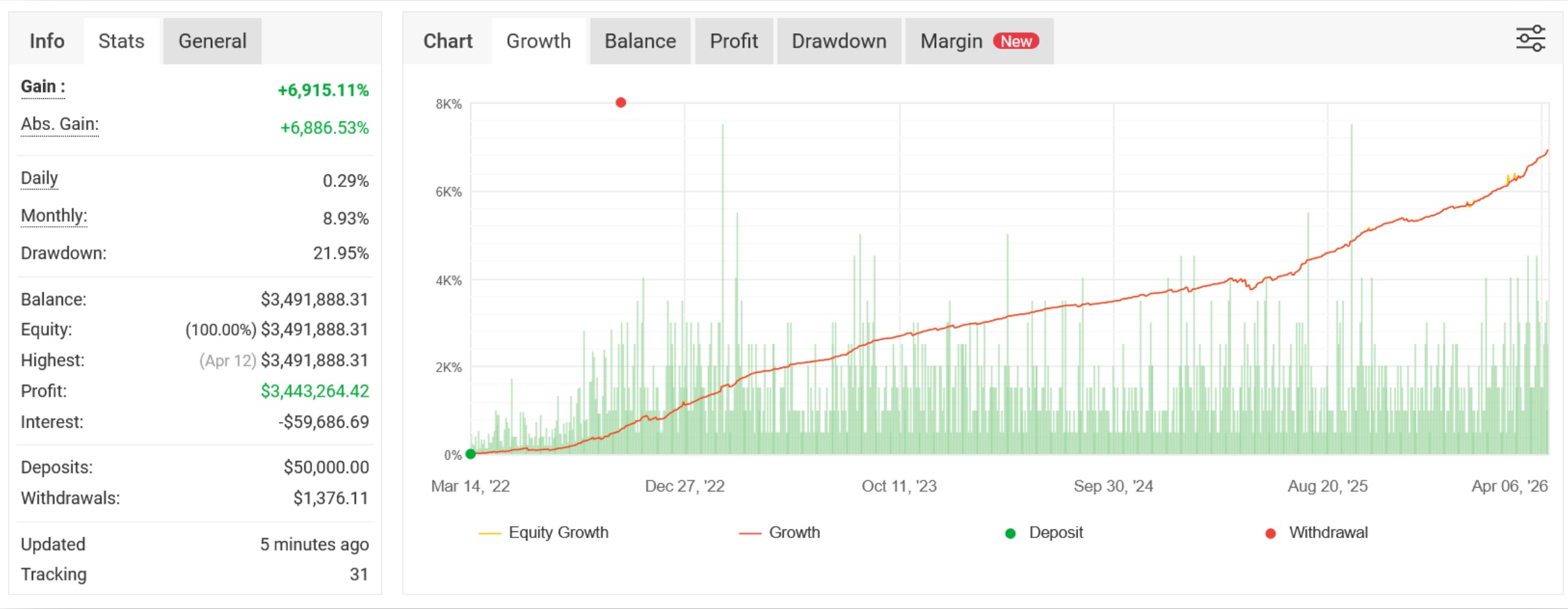
Myfxbook verified data: Real (USD) | MT4 | Both badges verified | Monthly: 8.93% average | Drawdown: 21.95% | Balance: $3,491,888 | Equity: 100% | Started: March 2022
Why it qualifies: Forex Robotron explicitly confirms no martingale or grid strategies, using controlled stop losses to manage risk. The $3.5M live balance with 100% equity (zero floating losses) across 4 years demonstrates that fixed-stop scalping can sustain large capital without the deferred loss structure martingale creates. The equity matching balance at all times is the critical signal — martingale EAs cannot maintain this because their floating losses always create a gap.
The honest caveat: 21.95% maximum drawdown is real — this is what non-martingale scalping drawdown looks like when losses are taken immediately rather than deferred. The equity curve is jagged with genuine pullbacks, not artificially smooth. Only $1,376 in withdrawals on $2.9M remains unexplained. Full verified data in the best MT4 forex robots comparison.
Best for: Traders who want high-frequency EUR-pair scalping without martingale exposure. Requires MT4 and standard account. Minimum recommended: $5,000.
2. FXStabilizer EUR Turbo — 10-Year Trend-Following, Defined Risk Per Trade
Strategy: Technical trend-following on EUR pairs. Entries based on market analysis with predefined stop loss levels. The strategy focuses on active risk control — each position has a defined maximum loss before the trade opens. No position averaging, no lot escalation after losses.
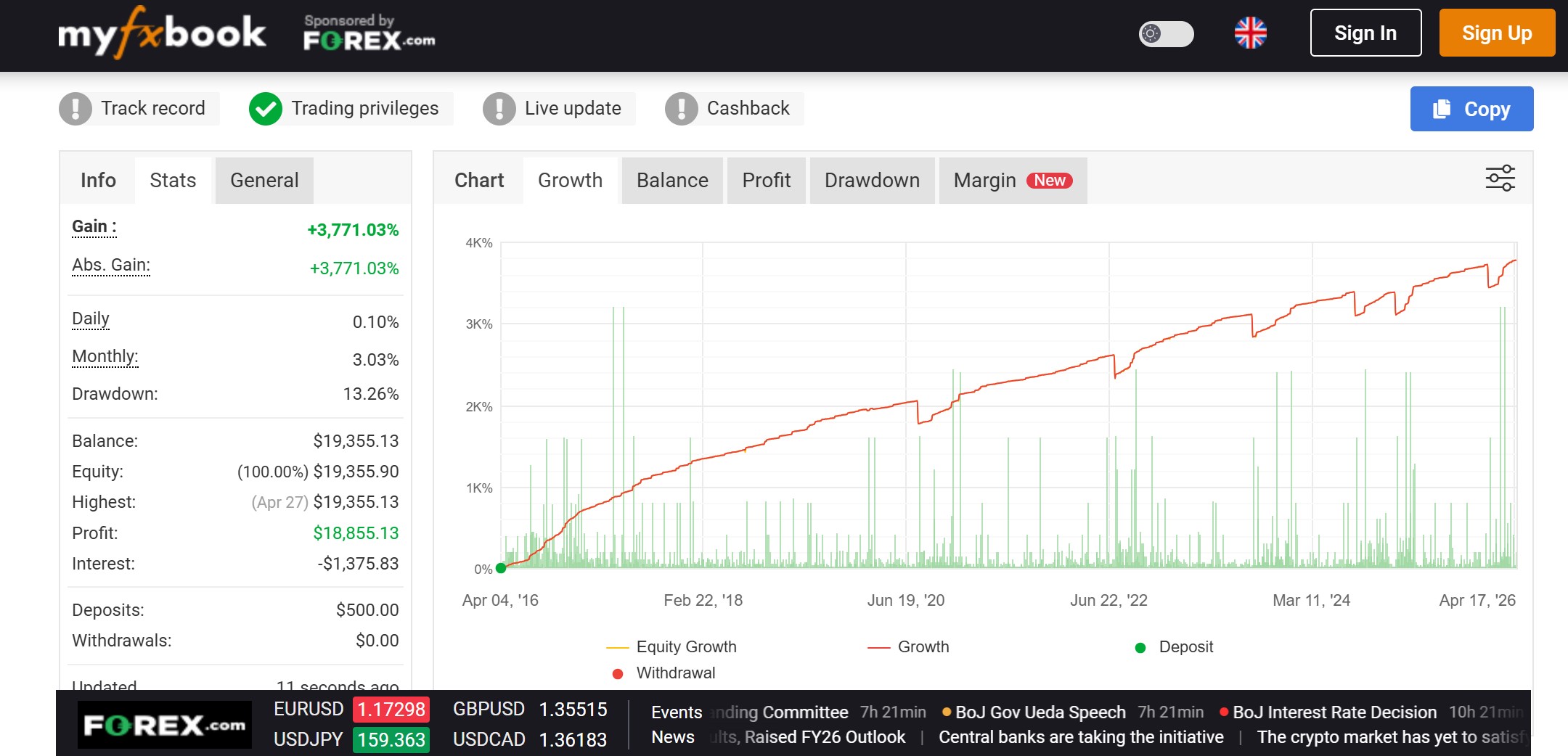
Myfxbook verified data: Real (USD) | MT4 | Both badges verified | Monthly: 3.03% | Drawdown: 13.26% | Balance: $19,355| Equity: 100% | Started: April 2016 | 10 years live
Why it qualifies: A decade of live verified trading with 13.26% maximum drawdown and equity permanently at 100% is the strongest long-term non-martingale proof available in retail EA data. Martingale EAs cannot maintain equity = balance across 10 years because the deferred losses eventually resolve — either in recovery or in a margin call. FXStabilizer’s equity has never meaningfully diverged from balance throughout its entire history.
The honest caveat: 3% monthly is conservative. Zero withdrawals in 10 years is unusual. The stair-step equity curve suggests the strategy is active in specific market conditions and flat in others — which is a sign of disciplined entry criteria, not a weakness. Full analysis in the consistent monthly profits EA guide.
Best for: Long-term compounders who want the lowest-risk non-martingale system with a decade of evidence. Minimum account: $500.
3. Forex Fury — Low-Volatility Window Scalping, 13 Years Operating
Strategy: Scalping during a narrow, pre-defined low-volatility trading window — typically the Asian session. The EA explicitly avoids high-impact news events and wide-spread periods. Each trade has a defined stop loss. Critically, the EA refuses to trade when market conditions fall outside its parameters — which reduces trade frequency but eliminates the scenario where martingale logic would be triggered.
Verified data: Multiple real Myfxbook accounts | MT4 and MT5 | Active since 2013 | Win rate: 93% | Target: 5–10% monthly at standard settings
Why it qualifies: Thirteen years of commercial operation without martingale is the strongest longevity signal on this list. Martingale EAs occasionally blow accounts — it is mathematically inevitable at sufficient market extremes. An EA operating for 13 years without restructuring after a catastrophic loss is strong evidence of a bounded-risk architecture. The 93% win rate comes from selectivity — the EA simply doesn’t trade when it would be likely to lose, rather than doubling down after losses.
The honest caveat: Low trade frequency means some months produce very few trades. Monthly returns at ultra-conservative settings are 1–3%. The narrow trading window means the EA is unexposed to most macro events — both a strength (avoids news-driven losses) and a limitation (misses news-driven gains). ECN account with tight spreads required.
Best for: Beginners who want a low-stress, well-documented non-martingale EA. Also ideal alongside a higher-frequency system for diversification. Minimum: $500 on ECN. Gold version available — see best gold forex robot guide.
4. SCR-EURAUD — 7-Year Trend System, 6% Maximum Drawdown
Strategy: Technical trend-following on the EUR/AUD pair. Operates with defined entry signals, fixed stop losses, and a win-rate-driven approach (73–75%). The average loss ($81.27) exceeds the average win ($49.07) — a negative R:R ratio compensated by high win frequency. No lot escalation, no position averaging.
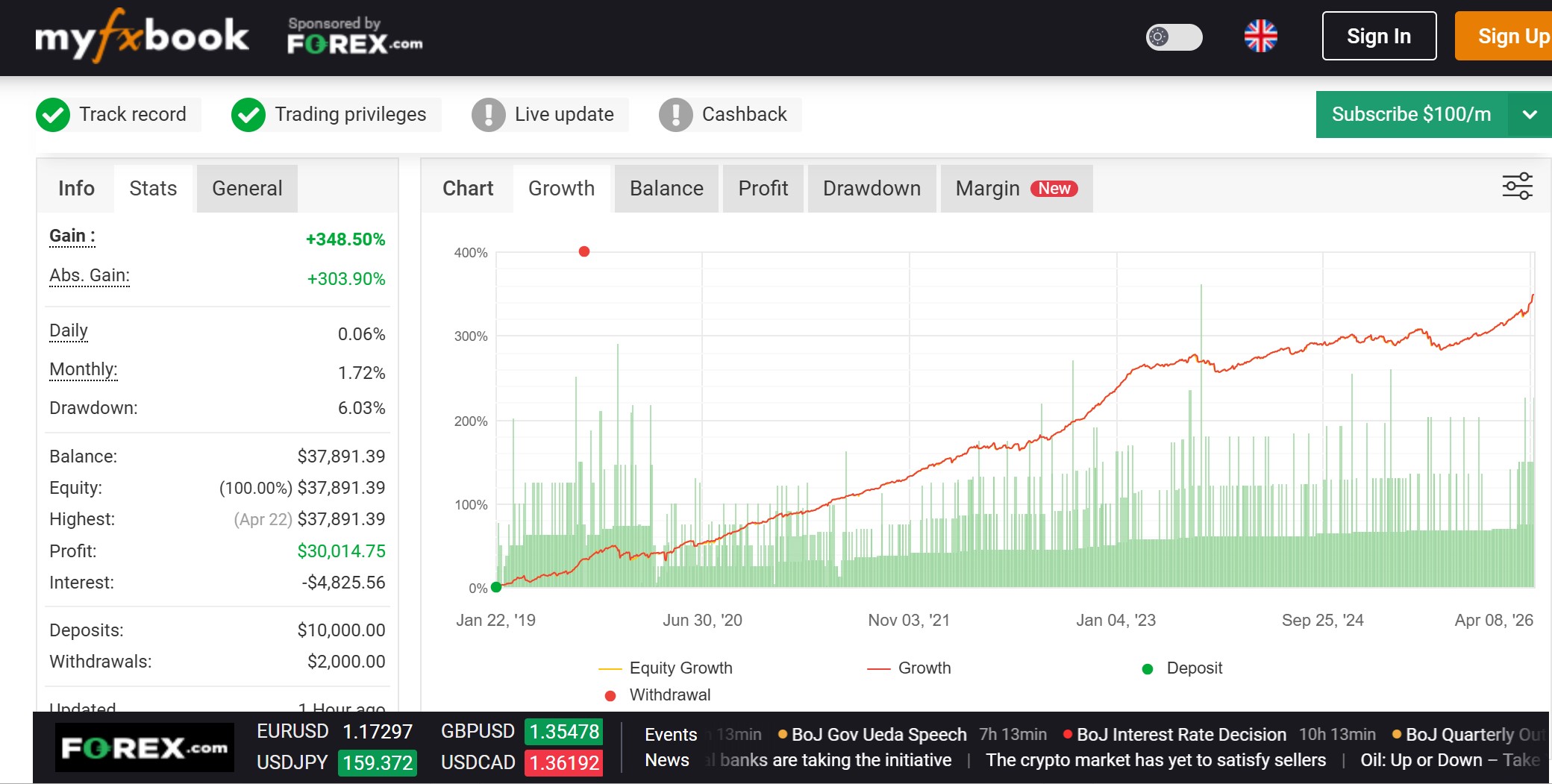
Myfxbook verified data: Real (USD) | IronFX | MT4 | Both badges verified | Monthly: 1.67% | Drawdown: 6.03% | Balance: $35,966 | Equity: 100% | Since: January 2019 | 1,757 trades
Why it qualifies: 6.03% maximum drawdown over 7 years — through COVID, inflation cycles, rate hiking regimes, and 2026’s geopolitical events — is the most capital-efficient non-martingale track record on this list. That drawdown level is only achievable with genuinely bounded risk per trade. A martingale system operating for 7 years would have encountered at least one sequence-destroying trending event in EUR/AUD — and EUR/AUD has had several significant trend periods since 2019. The absence of catastrophic drawdown confirms the risk architecture is not martingale.
The honest caveat: 1.67% monthly is very conservative. Live Update not active. Average loss larger than average win creates fragility during extended losing streaks.
Best for: Conservative capital preservation. Ideal as a low-risk anchor in a multi-EA portfolio.
5. Beetle EA — Swing Trading, $30,000 in Verified Withdrawals
Strategy: Swing trading with 3-day average trade duration. Enters on defined technical signals, holds positions for days, closes at take profit or stop loss. Fixed lot sizing per trade — not adjusted based on previous trade outcomes. Profit factor 2.60 across 856 trades confirms each trade is independently sized and risk-managed.
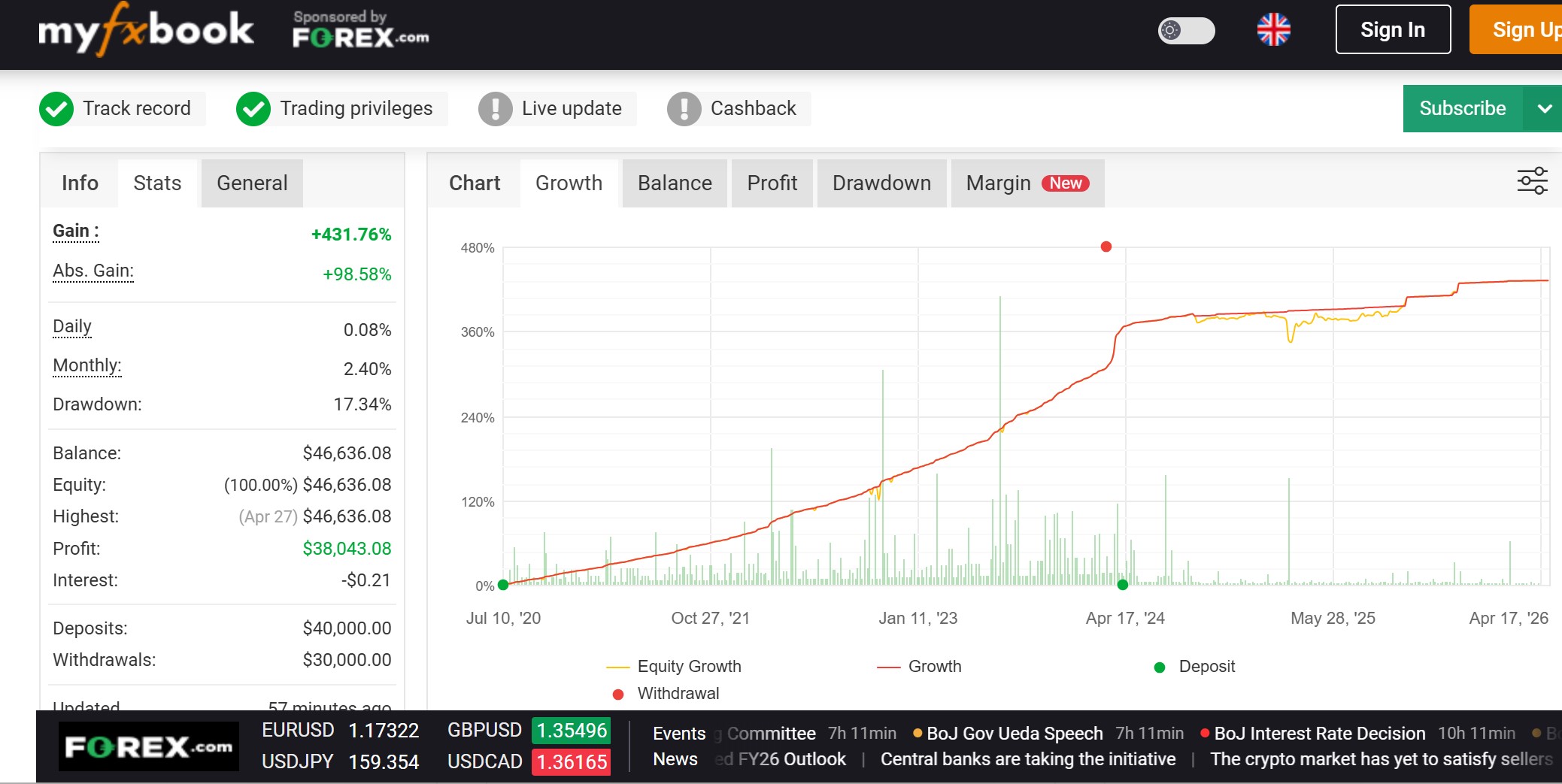
Myfxbook verified data: Real (USD) | Lirunex | MT4 | Both badges verified | Monthly: 2.44% | Drawdown: 17.34% | Balance: $46,597 | Equity: 100% | Since: July 2020 | Withdrawals: $30,000
Why it qualifies: The $30,000 in verified real withdrawals across 5+ years is the most concrete non-martingale proof available: real money extracted repeatedly from a live account, with the account continuing to grow. A martingale EA generates withdrawable profit in its winning phases — but the losses come in sudden catastrophic events. Beetle’s withdrawal history is steady and consistent, not front-loaded before a blow-up. The profit factor of 2.60 means for every $1 lost, $2.60 was made — independently per trade, not recovered through doubling.
The honest caveat: 17.34% drawdown is the highest on this list. Monthly returns have declined recently, possibly reflecting strategy sensitivity to current market conditions. Lirunex is not a tier-1 ECN broker.
Best for: Swing traders who want verified withdrawal proof and a multi-year track record. Minimum recommended: $5,000.
Which Non-Martingale EA for Which Trader
| Profile | EA | Strategy Type | Monthly | Max DD | Minimum Account |
|---|---|---|---|---|---|
| Conservative, capital preservation | SCR-EURAUD | Trend-following | 1.67% | 6% | $1,000 |
| Long-term compounder, set-and-forget | FXStabilizer EUR Turbo | Trend-following | 3% | 13% | $500 |
| Beginner, low-stress, ECN scalping | Forex Fury | Low-volatility window scalping | 3–10%* | ~15% | $500 ECN |
| Swing trader, wants withdrawal proof | Beetle EA | Swing trading | 2.44% | 17% | $5,000 |
| Aggressive, high-frequency scalper | Forex Robotron | Night scalping | 9% | 22% | $5,000 |
*Forex Fury returns vary significantly by settings. Ultra-conservative: 1–3%. Standard: 5–10%.
The key insight across all five: every drawdown number above represents real losses taken at market pace — not deferred losses hiding in open positions. A 22% drawdown on Forex Robotron is visible in the equity curve as actual dips. A martingale EA showing 5% drawdown may be hiding 40% in open floating positions. The drawdown you can see and plan for is always safer than the drawdown that appears suddenly when a position basket fails to recover.
Before selecting any EA — martingale or non-martingale — verify the Myfxbook statement using the balance vs equity gap check and the Martingale detection signals. For the complete verification guide, see how to read a Myfxbook statement.
If you are deciding between a gold EA and a forex pair EA — which is a separate but related decision — the analysis in gold EA vs forex EA for small accounts covers the pip value, spread, and lot sizing differences that determine which is suitable for your capital level.
Frequently Asked Questions
What is a martingale forex robot?
A martingale forex robot is an EA that doubles or multiplies its lot size after each losing trade, betting that the next winning trade will recover all previous losses plus a small profit. The math works in calm, ranging markets. It fails — often catastrophically — when markets enter sustained directional moves driven by news, policy changes, or macro events that do not reverse within the account’s margin capacity.
How do I know if a forex robot uses martingale?
Four signals in Myfxbook trade history: (1) Lot sizes increasing as price moves against the position — a sequence like 0.01, 0.02, 0.04, 0.08. (2) Multiple trades closing at the exact same timestamp — a basket recovery close. (3) Perfectly smooth equity curve with almost no visible drawdown dips — losses deferred, not closed. (4) Open trades hidden or private — almost always concealing a large floating drawdown. For the full detection guide, see how to read a Myfxbook statement.
Are grid trading EAs the same as martingale EAs?
Not exactly, but they share the same fundamental risk. Pure grid EAs open positions at fixed intervals with the same lot size every level — no multiplication. Martingale EAs double lot size with each level. Many commercial EAs use hybrid approaches with mild lot multipliers (1.2–1.5x per level). Even a 1.5x multiplier compounds rapidly across 8–10 levels: a 0.01 lot base becomes 0.17 lots by level 8. The safest grid EAs maintain fixed lots throughout — no multiplication at any level.
What strategy do non-martingale forex robots use instead?
Non-martingale EAs give every trade a predefined, fixed stop loss and fixed lot size — regardless of previous trade outcomes. The three most common approaches in verified live EAs are: scalping (small targets, tight stops, high frequency), trend-following (enters in the direction of momentum, exits on reversal signal or stop), and low-volatility window trading (trades only during specific session hours when spread and noise are minimal). Each trade is structurally independent — a loss does not change the next trade’s size.
