You have $500 or less than that and you want to run a forex robot. I know you. The question is whether to start with a gold (XAUUSD) EA or a forex pair EA. The answer is not obvious, and most content online skips the math that actually determines it. This article runs those numbers for small accounts specifically, spread cost per trade, viable lot sizes, strategy survival rates, and when gold becomes the right choice at small capital.
What’s the Same and What’s Different at Micro Lot
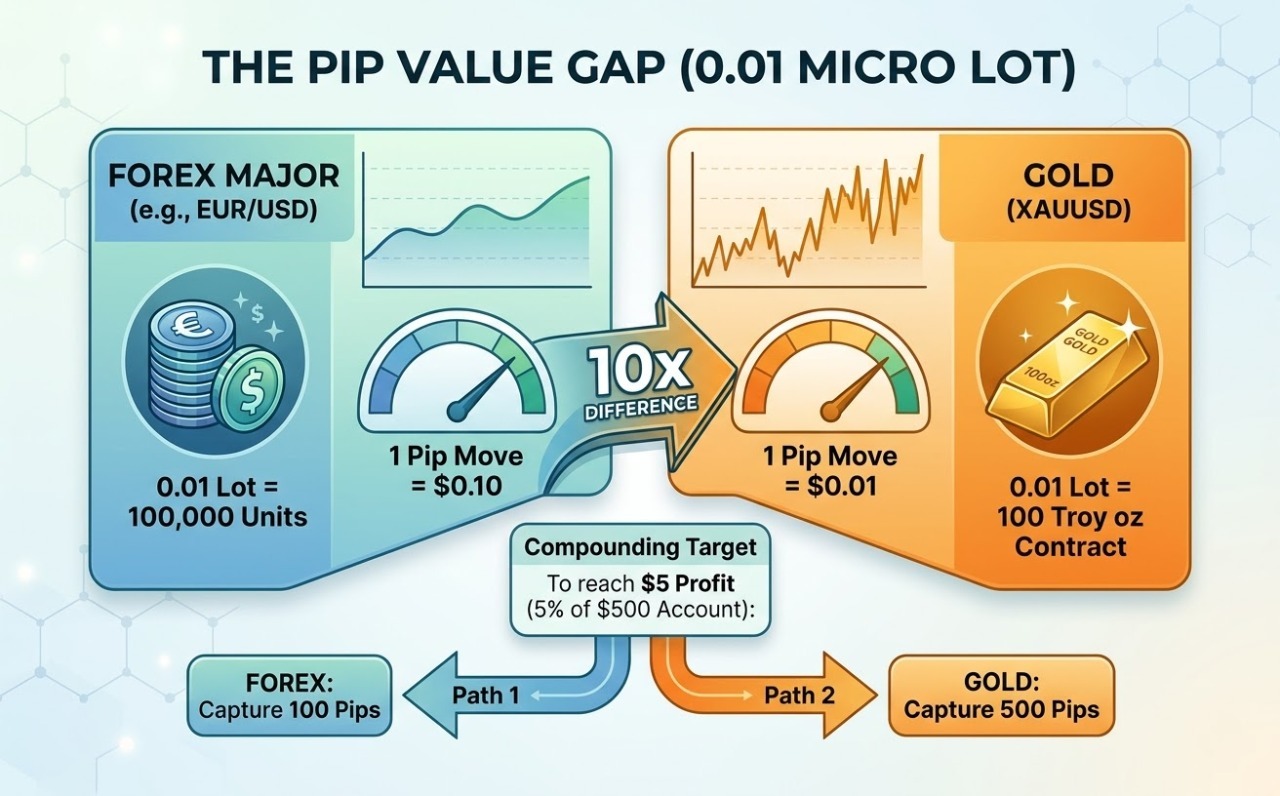
The most important thing to understand before comparing gold EAs and forex EAs is that pip value at micro lot is not the same across instruments. XAUUSD calculates differently from standard forex pairs — and getting this wrong leads to serious lot sizing errors.
Here is the correct pip value at 0.01 lot for each instrument:
| Instrument | Lot Size | 1 Pip = Price Move | Contract Size | Pip Value (USD) | 100-pip move = |
|---|---|---|---|---|---|
| EUR/USD | 0.01 (micro) | 0.0001 | 100,000 units | $0.10 per pip | $10.00 |
| GBP/USD | 0.01 (micro) | 0.0001 | 100,000 units | $0.10 per pip | $10.00 |
| XAUUSD (Gold) | 0.01 (micro) | $0.01 price move | 100 troy oz | $0.01 per pip | $1.00 |
The math: XAUUSD pip value at 0.01 lot = $0.01 (pip size) × 100 oz (contract) × 0.01 (lot size) = $0.01 per pip. A 100-pip gold move at 0.01 lot returns $1.00 — not $10.00 as it would on EURUSD at the same lot size.
This 10× difference in pip value per lot has direct consequences for small account traders. To generate the same dollar return as a forex EA trading 0.01 lots, a gold EA must either:
- Capture 10× more pips per trade — possible given gold’s larger daily range, or
- Trade 10× larger lot size (0.10 lots instead of 0.01) — which creates a very different risk profile at $500
Trading 0.10 lots on gold at $500 with a 100-pip stop loss risks $10 per trade — 2% of the account in a single trade. That is already above the standard 1% risk-per-trade recommendation. This is where small account gold EA trading starts to compress against its own constraints.
The core differences that drive all small account decisions are: pip value, spread cost, stop loss distance, and daily range — and how they interact specifically at sub-$500 capital. Use the pip value calculator to confirm exact values for your specific lot size before configuring any EA.
Spread Cost at Small Account: Gold vs Forex
Spread is a fixed cost on every trade, regardless of account size. On a $500 account trading 0.01 lots, here is what each trade costs in spread before price has moved at all. Note: XAUUSD spread cost uses $0.01/pip pip value — not $0.10 as on forex pairs.
| Instrument | Account Type | Typical Spread | Pip Value at 0.01 lot | Spread Cost per Trade | Trades/Day to cost 1% of $500 |
|---|---|---|---|---|---|
| EUR/USD | Standard | 1.5 pips | $0.10/pip | $0.015 | 333 trades |
| EUR/USD | ECN | 0.3 pips | $0.10/pip | $0.003 | 1,667 trades |
| GBP/USD | Standard | 2.0 pips | $0.10/pip | $0.020 | 250 trades |
| XAUUSD | Standard | 30 pips | $0.01/pip | $0.03 | 167 trades |
| XAUUSD | ECN | 8 pips | $0.01/pip | $0.008 | 625 trades |
The corrected numbers reveal a more nuanced picture than most beginners expect. At 0.01 lot, gold’s spread cost in dollars is actually comparable to forex — because gold’s lower pip value ($0.01/pip) offsets its higher pip spread. At standard account, XAUUSD costs $0.03 per trade vs $0.015 for EURUSD — only 2× higher, not 20× as it first appears when comparing raw pip counts.
However, this changes significantly when you scale lot size. To generate meaningful dollar returns on gold at 0.01 lot ($0.01/pip), most traders need to run higher lot sizes — 0.10 lots or more. At 0.10 lots, XAUUSD pip value rises to $0.10/pip and spread cost rises proportionally:
| Instrument | Account Type | Spread | Lot Size needed for $1/pip | Spread Cost at that lot | Trades/Day to cost 1% of $500 |
|---|---|---|---|---|---|
| EUR/USD | Standard | 1.5 pips | 0.10 lots | $0.15 | 33 trades |
| EUR/USD | ECN | 0.3 pips | 0.10 lots | $0.03 | 167 trades |
| XAUUSD | Standard | 30 pips | 1.00 lot | $3.00 | 2 trades |
| XAUUSD | ECN | 8 pips | 1.00 lot | $0.80</ | 6 trades |
This is where the real problem emerges. To achieve $1.00 per pip on XAUUSD, you need 1.00 standard lot — which requires significantly more margin than 0.10 lots on EURUSD for the same pip value. A standard account with $500 cannot safely run 1.00 lot on gold. It can safely run 0.10 lots on EURUSD. This is the practical constraint that makes gold EAs harder to run profitably on small accounts — not spread pip count alone, but the lot size required to generate meaningful returns relative to available capital.
The conclusion for spread cost: At 0.01 lot, gold spread cost is only moderately higher than forex. The real constraint is that gold requires larger lot sizes to generate meaningful dollar returns — and those larger lots on a standard account carry spread costs that consume a significant portion of profit targets. ECN accounts partially solve this, but lot size requirements relative to account size remain the binding constraint for small account gold EA trading.
Lot Sizing Reality for $500 Accounts
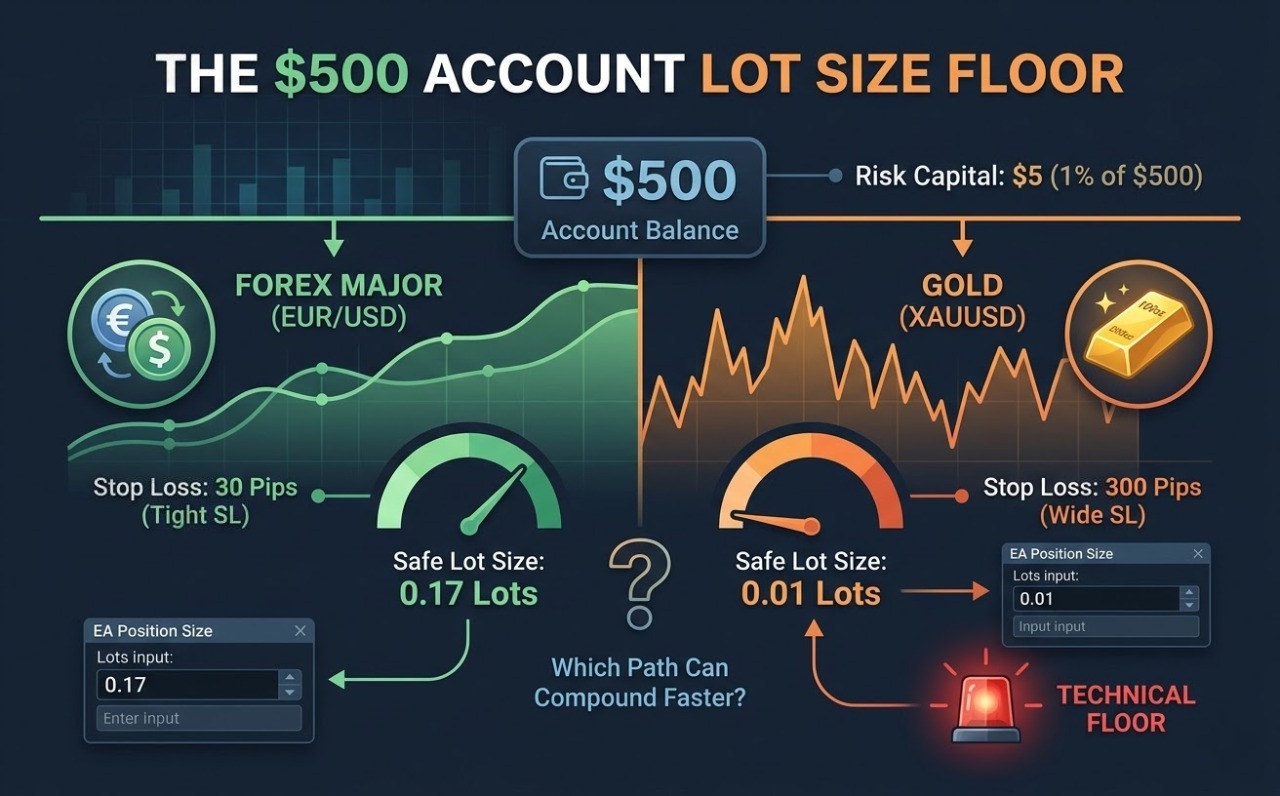
The second major difference at small accounts is stop loss distance — which directly controls lot size at a given risk percentage.
Gold requires much wider stop losses than forex pairs because its daily range is 10–20× larger. A 30-pip stop loss that is reasonable on EURUSD gets triggered by normal XAUUSD intraday noise. Gold EAs typically use stop losses of 100–300 pips minimum to avoid being stopped out on normal market movement.
| Instrument | Account | Risk % | Risk $ | SL Distance | Safe Lot Size |
|---|---|---|---|---|---|
| EUR/USD | $500 | 1% | $5 | 30 pips | 0.17 lots |
| EUR/USD | $500 | 1% | $5 | 50 pips | 0.10 lots |
| GBP/USD | $500 | 1% | $5 | 40 pips | 0.13 lots |
| XAUUSD | $500 | 1% | $5 | 100 pips | 0.05 lots |
| XAUUSD | $500 | 1% | $5 | 200 pips | 0.02 lots |
| XAUUSD | $500 | 1% | $5 | 300 pips | 0.01 lots |
At 300-pip gold stop loss (common for swing gold EAs), the correct lot size at 1% risk on $500 is 0.01 lots — the absolute minimum tradeable on most brokers. The EA is operating at the floor of what is mechanically possible. Any increase in stop loss, drawdown, or loss streak immediately pushes below minimum lot. The account has no room.
A EURUSD EA with a 50-pip stop loss at 1% risk can trade 0.10 lots — 10× more volume at the same dollar risk level. This means more meaningful trade outcomes and more compounding potential per trade, not just technically-viable minimum positions.
Use the forex position size calculator to run these numbers for your exact account size and stop loss distance before setting any EA’s lot size parameter.
Which Strategy Types Survive at $500
Not all EA strategies are equally viable at $500. The account size constraint eliminates some strategy types entirely.
Gold Scalping EA — Marginal at $500, Standard Account
The spread cost problem for gold scalping EAs is not in the dollar cost at 0.01 lot — it is in the lot size required to generate meaningful dollar returns. A gold scalping EA targeting 30-pip profits at 0.01 lot earns $0.30 per winning trade. To generate $5 per trade (a meaningful return on $500), it needs 0.17 lots. At 0.17 lots on a standard account with 30-pip spread, the spread cost is $0.51 per trade — 10.2% of the $5 target consumed before price moves at all. On ECN at 8-pip spread, the same 0.17 lots costs $0.14 per trade — 2.8% of target. ECN makes gold scalping viable; standard accounts do not.
Forex Major Pair Scalping EA — Viable at $500 on Standard Account
At 0.10 lots on EURUSD standard account, spread cost is $0.15 per trade. Targeting 20-pip profits ($2.00 per trade), spread consumes 7.5% of the target — manageable. Monthly at 20 trades/day: approximately $90 in spread costs, which represents 18% of account. The EA needs 18%+ monthly return to cover spread — high but achievable for verified scalping EAs with 200+ monthly trades. Spread cost as a constraint is real but significantly lower than the gold ECN equivalent in dollar terms.
Gold Trend-Following EA — Viable at $500 on ECN, Tight Parameters
Fewer trades per day (2–5 typically), wider targets, lower spread cost impact per month. The challenge is stop loss width — a 200-pip gold stop at 1% risk forces 0.02–0.03 lots, leaving the account with almost no room for drawdown before hitting minimum lot threshold.
Grid or Martingale Gold EA — Not Viable at $500
Grid EAs require capital to support multiple simultaneous open positions averaging down. A grid that opens 5 positions at different price levels on a $500 account allocates $100 of margin per position at best. When the grid extends under adverse conditions, margin is exhausted before the basket can close in profit. Grid gold EAs need $3,000 or more to operate with any safety margin.
Forex Trend-Following EA — Viable at $500
Moderate trade frequency, defined stop losses, manageable spread costs. Major forex pairs provide sufficient daily range (50–150 pips) for meaningful entries without the extreme stop distances required for gold.
| Strategy Type | Instrument | Viable at $500? | Main Constraint |
|---|---|---|---|
| Scalping | Forex (standard account) | ✅ Yes | None significant at this account size |
| Scalping | Gold (ECN only) | ⚠️ Marginal | Spread cost 9–15% of account per month |
| Scalping | Gold (standard account) | ❌ No | Spread consumes target before price moves |
| Trend-following | Forex | ✅ Yes | None significant |
| Trend-following | Gold (ECN) | ⚠️ Marginal | Stop loss width forces minimum lot — no room for drawdown |
| Grid / Hedge | Gold | ❌ No | Insufficient margin for grid expansion |
| Grid / Hedge | Forex | ❌ No | Same margin problem — needs $2,000+ minimum |
The Compounding Argument — Does Gold Win?
The argument often made for gold EAs on small accounts is that gold’s larger daily range means more pips available to capture, which translates into faster compounding. This argument breaks down when you apply the correct pip value math.
At 0.01 lot, gold generates $0.01 per pip — not $0.10. A gold EA capturing 500 pips per month at 0.01 lot generates only $5.00. A forex EA capturing 100 pips per month at 0.01 lot generates $10.00. Gold needs to capture 5× more pips just to match the same dollar return at the same lot size.
Compounding speed is determined by monthly return percentage on starting balance. To make the comparison fair, both EAs must achieve the same percentage return. On $500 targeting 5% monthly ($25):
- Forex EA path: 0.10 lot on EURUSD, 50-pip average win per trade, 5 trades per month. Each win = $5.00. Total = $25. Standard account, no ECN required, stop losses 30–50 pips wide.
- Gold EA path at 0.01 lot: Needs 2,500 pips per month to generate $25 at $0.01/pip. Not realistic for most strategies.
- Gold EA path at 0.10 lot: Pip value = $0.10/pip. Needs 250 pips per month. Achievable — but 0.10 lot on gold with a 150-pip stop loss risks $15 per trade (3% of $500 account). Above safe risk-per-trade threshold.
- Gold EA path at 0.05 lot: Pip value = $0.05/pip. Needs 500 pips per month. Stop loss 100 pips = $5 risk per trade (1% of $500). Viable on ECN — but requires consistent 500-pip monthly capture on XAUUSD and ECN account conditions.
The forex path reaches the same 5% monthly target with lower lot size, tighter stop losses, no ECN requirement, and lower spread cost per trade. At $500 specifically, the forex EA path has significantly fewer points of failure.
Gold’s compounding advantage over forex becomes meaningful when the account grows large enough that lot sizing can step up proportionally — typically at $1,000 or above for non-grid gold EAs, where XAUUSD’s larger daily pip range starts working in the EA’s favour rather than against it.
When a Gold EA Makes Sense for Small Accounts
The analysis above does not mean gold EAs are always wrong for small accounts. Three situations make a gold EA the right choice even at $500 or less:
1. You Have Access to an ECN Account with Sub-10-Pip Gold Spread
On a genuine ECN account where XAUUSD spread is consistently 3–8 pips, the spread cost equation changes enough to make a low-frequency gold trend EA viable. The condition is that the EA trades infrequently — 2–5 trades per week — so monthly spread cost stays below 3–4% of the account.
2. The Gold EA Is Specifically Designed for Micro Accounts
Some gold EAs are built with micro lot sizing and small account parameters as design constraints — not afterthoughts. These EAs use tight stop losses (50–100 pips instead of 200–300), target achievable pip returns at micro lot sizes, and are tested on $300–$500 accounts specifically. They exist but are rare. Look for verified Myfxbook data on accounts that started below $1,000.
3. You Are Using a Cent Account
On a cent account, the effective lot size is 100× smaller than a standard account. This creates the account room that a small balance gold EA needs. See the cent account section below for the full mechanics and trade-offs.
Cent Accounts: The Small Account Gold EA Path
A cent account is a trading account where the balance is denominated in cents rather than dollars. A $50 deposit appears as 5,000 cents in the platform. Lot sizes are proportionally smaller — what the platform shows as “1 lot” is actually 0.01 standard lot in real terms.
For gold EA traders with small capital, this creates a practical solution to the stop loss width problem:
| Account Type | Deposit | “1 lot” = real exposure | Gold pip value at “1 lot” | 200-pip SL cost at 1% risk | Safe lot size (gold) |
|---|---|---|---|---|---|
| Standard | $500 | 100 troy oz per lot | $1.00/pip at 1.00 lot / $0.01/pip at 0.01 lot | $5 (1% of $500) | 0.02 lots → $0.02/pip |
| Cent | $50 (= 5,000 cents) | 1 troy oz per “1 lot” (cent) | $0.01/pip at “1 lot” cent = $0.0001/pip real | 5 cents (1% of 500c) = $0.05 real | “0.02 lots” cent = 0.0002 real standard lots |
On a cent account, a gold EA with a 200-pip stop loss is trading with $0.002 per pip real exposure at micro cent lot. The account can absorb hundreds of stop loss hits before account damage is meaningful in real dollar terms. This is why cent accounts are the recommended starting point for testing any gold EA with small capital.
The trade-offs to understand before depositing on a cent account:
- Profits are also in cents — a “300% gain” on a $50 cent account is $150 in real money
- Spread cost is the same percentage — a 30-pip spread on gold costs the same proportion of the account regardless of denomination
- Cent accounts are for learning, testing, and building confidence — not for primary capital growth at scale
- Not all brokers offer cent accounts — and those that do may have different execution quality than their standard accounts
To understand how to read a gold EA’s verified performance data before committing to any account type, see how to read a Myfxbook statement — particularly the balance vs equity section and how to detect hidden floating losses.
Decision Table: Gold EA or Forex EA by Account Size
Based on the analysis above, here is the direct recommendation by account size and account type:
| Account Size | Account Type | Recommendation | Reasoning |
|---|---|---|---|
| Under $100 | Any standard | ❌ Neither — not ready for live trading | Below minimum viable margin for any EA strategy |
| Under $100 | Cent account | ⚠️ Gold EA possible for testing only | Cent account reduces real exposure to manageable levels |
| $100–$300 | Standard | ✅ Forex EA (major pairs) | Low spread, viable lot sizes, no ECN requirement |
| $100–$300 | Cent account | ⚠️ Gold EA for testing | Real dollar gains minimal but execution experience is valid |
| $300–$500 | Standard | ✅ Forex EA (major pairs) | Spread cost and lot sizing both more manageable than gold |
| $300–$500 | ECN | ⚠️ Gold EA (low-frequency only) | Max 2–5 trades/week to keep spread cost under 3% monthly |
| $500–$1,000 | ECN | ✅ Gold EA viable (non-grid) | Account has enough room for gold stop losses without hitting lot minimum |
| $1,000–$3,000 | ECN | ✅ Gold EA or Forex EA — strategy dependent | Both viable. Choose based on strategy type and verified Myfxbook performance. |
| $3,000+ | ECN | ✅ Gold EA including grid strategies | Account large enough to support grid expansion and drawdown cycles |
For verified gold EAs with minimum deposit requirements, drawdown data, and live Myfxbook performance, the best gold forex robot guide covers systems that have been tested in live market conditions including the high-volatility Q1 2026 period.
For forex pair EAs ranked by verified live data across MT4-compatible systems, the best MT4 forex robots comparison shows equity-adjusted performance across accounts starting under $1,000.
Before configuring the lot size parameter in any EA’s Inputs tab, run the numbers through the forex position size calculator with your actual account balance and the EA’s stop loss distance. The output tells you the correct safe lot size — which should then be compared against the EA’s minimum lot requirement to confirm the account is large enough for the strategy.
Frequently Asked Questions
Is a gold EA or forex EA better for a $500 account?
For most $500 accounts on standard brokers, a forex pair EA is the safer and more cost-effective starting point. Gold’s 20–35 pip standard spread is 10–20× higher than major forex pairs, consuming a disproportionate share of profit targets at small lot sizes. A gold EA becomes genuinely viable at $500 on an ECN account with consistent XAUUSD spreads below 10 pips — but requires low trade frequency to keep monthly spread costs manageable.
Can I run a gold EA with $100?
On a standard or ECN account, $100 is not sufficient for any gold EA to trade safely. The minimum viable account for a non-grid gold scalper is $300–$500 on ECN. On a cent account — where 1 lot equals 0.001 real standard lot — $100 provides enough room to test gold EA behaviour without meaningful capital risk. Cent accounts are appropriate for learning and verification, not for primary capital growth.
What lot size should I use for a $500 forex EA account?
At $500 with 1% risk and a 30-pip stop loss on a major forex pair, the correct lot size is 0.17 lots. At 50-pip stop loss, it is 0.10 lots. For gold at $500 with 1% risk and 100-pip stop loss, the correct lot size is 0.05 lots. At 200-pip gold stop loss, it drops to 0.02 lots — approaching minimum viable. Use the position size calculator to confirm for your specific parameters before touching any EA input settings.
Does gold EA or forex EA compound faster on a small account?
Neither compounds faster by default — compounding speed depends on monthly return percentage, not the instrument. However, the math of achieving a target return is harder on gold at small lot sizes. At 0.01 lot, gold generates $0.01 per pip vs $0.10 per pip for EURUSD. A gold EA needs to capture 10× more pips than a forex EA at the same lot size to generate identical dollar returns. To compensate, gold EAs must run higher lot sizes — which require wider stop losses and more margin than a $500 account comfortably provides. At $500, forex EAs reach the same monthly return target with smaller lot sizes, tighter stops, and lower spread cost per trade.
Should I use a cent account for a gold EA?
A cent account is the most practical path for running a gold EA with under $300 in real capital. The 100× reduction in effective lot size gives the EA room to handle gold’s wide stop losses without destroying the account on a single bad trade. The trade-off: profits are proportionally small in real dollar terms, and a cent account is a learning tool rather than a capital growth vehicle. Use it to verify the EA’s real-market behaviour, then move to a standard ECN account once you have confirmed it performs as expected.

Work my fulltime job as the developer and writer for Oreshnikbot.com now. Have been working on forex and forex EAs for 10 years.