If you’re new to forex trading, you’ve probably heard the term “pip” thrown around a lot. But what exactly is a pip, and why is it so important? In this comprehensive guide, we’ll break down everything you need to know about pips in simple terms, complete with practical exercises to help you master this fundamental concept.
What is a Pip?
A pip (short for “percentage in point” or “price interest point”) is the smallest unit of measurement for price movements in forex trading. Think of it as the “penny” of the forex world – it’s the basic unit traders use to measure how much a currency pair has moved up or down.
Key Points About Pips:
- Pips measure the change in value between two currencies
- They help traders calculate profits and losses
- Most currency pairs use the 4th decimal place as one pip
- Japanese Yen (JPY) pairs use the 2nd decimal place as one pip
How Big is One Pip?
The size of one pip depends on the currency pair you’re trading:
Standard Currency Pairs (Most Pairs)
- One pip = 0.0001 (4th decimal place)
- Examples: EUR/USD, GBP/USD, AUD/CAD, EUR/GBP
Example: If EUR/USD moves from 1.0750 to 1.0751, that’s a 1 pip increase.
Japanese Yen (JPY) Pairs
- One pip = 0.01 (2nd decimal place)
- Examples: USD/JPY, EUR/JPY, GBP/JPY, NZD/JPY
Example: If USD/JPY moves from 148.25 to 148.26, that’s a 1 pip increase.

Why Do JPY Pairs Use Different Pip Sizes?
Japanese Yen pairs use larger pip sizes because the Yen’s value is much smaller compared to other major currencies. For instance, 1 USD equals about 148 JPY, so using the 4th decimal place would make movements too tiny to be meaningful.
What is a Pipette?
You might also see a 5th decimal place (or 3rd for JPY pairs) – this is called a pipette or fractional pip. It equals 1/10th of a pip. For simplicity in learning, we’ll focus on full pips in our exercises.
Basic Formula for Calculating Pips
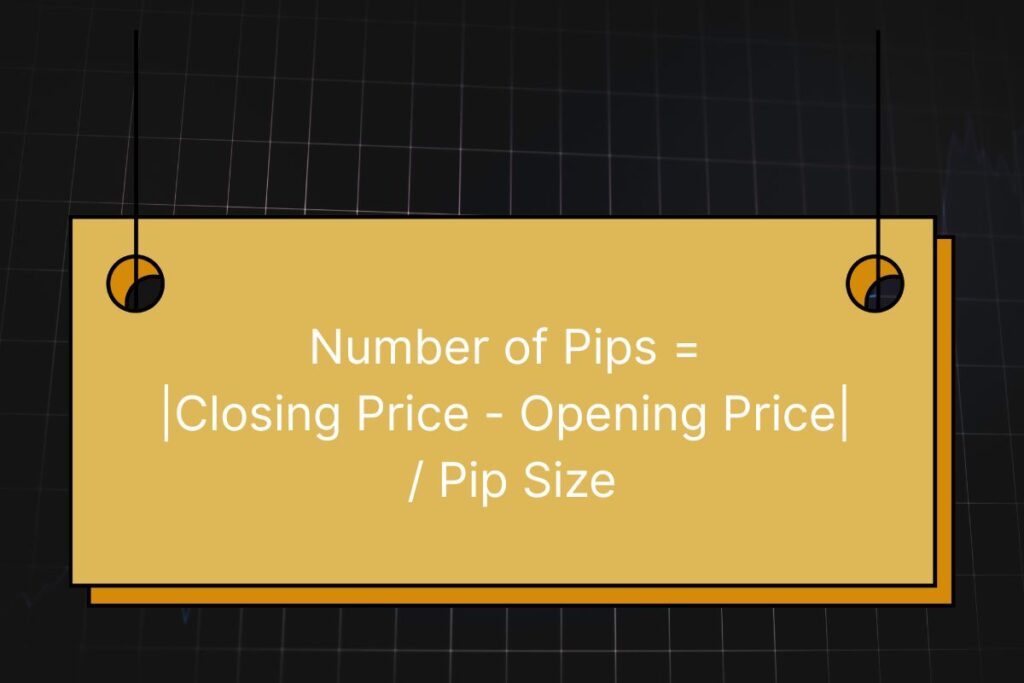
Here’s the simple formula to calculate pip movement:
Number of Pips = |Closing Price - Opening Price| / Pip Size
Where:
- Pip Size = 0.0001 for most pairs
- Pip Size = 0.01 for JPY pairs
- Use absolute value (ignore negative signs) to get pip count
Practical Exercise: Calculate Pip Movements
Now let’s practice! Below are 6 real trading scenarios. Try to calculate the pip movements and determine if each trade resulted in a profit or loss.
Exercise Instructions:
- Use the formula above to calculate pip movements
- Determine if the trade was profitable or not:
- Buy (Long) trades: Profit if closing price > opening price
- Sell (Short) trades: Profit if closing price < opening price
Practice Problems:
| # | Currency Pair | Opening Price | Trade Type | Closing Price | Pip Movement | Profit/Loss |
|---|---|---|---|---|---|---|
| 1 | EUR/USD | 1.0750 | Buy | 1.0795 | ? | ? |
| 2 | GBP/USD | 1.2588 | Sell | 1.2543 | ? | ? |
| 3 | USD/JPY | 148.25 | Buy | 148.60 | ? | ? |
| 4 | AUD/CAD | 0.9015 | Sell | 0.9030 | ? | ? |
| 5 | NZD/JPY | 93.45 | Sell | 93.30 | ? | ? |
| 6 | EUR/GBP | 0.8672 | Buy | 0.8659 | ? | ? |
Answer Key and Explanations
1. EUR/USD (Pip Size: 0.0001)
- Calculation: |1.0795 – 1.0750| / 0.0001 = 0.0045 / 0.0001 = 45 pips
- Result: Bought at lower price, sold at higher price → Profit
2. GBP/USD (Pip Size: 0.0001)
- Calculation: |1.2543 – 1.2588| / 0.0001 = 0.0045 / 0.0001 = 45 pips
- Result: Sold at higher price, closed at lower price → Profit
3. USD/JPY (Pip Size: 0.01)
- Calculation: |148.60 – 148.25| / 0.01 = 0.35 / 0.01 = 35 pips
- Result: Bought at lower price, sold at higher price → Profit
4. AUD/CAD (Pip Size: 0.0001)
- Calculation: |0.9030 – 0.9015| / 0.0001 = 0.0015 / 0.0001 = 15 pips
- Result: Sold at lower price, closed at higher price → Loss
5. NZD/JPY (Pip Size: 0.01)
- Calculation: |93.30 – 93.45| / 0.01 = 0.15 / 0.01 = 15 pips
- Result: Sold at higher price, closed at lower price → Profit
6. EUR/GBP (Pip Size: 0.0001)
- Calculation: |0.8659 – 0.8672| / 0.0001 = 0.0013 / 0.0001 = 13 pips
- Result: Bought at higher price, sold at lower price → Loss
Final Results Table:
| # | Currency Pair | Opening Price | Trade Type | Closing Price | Pip Movement | Profit/Loss |
|---|---|---|---|---|---|---|
| 1 | EUR/USD | 1.0750 | Buy | 1.0795 | 45 pips | Profit |
| 2 | GBP/USD | 1.2588 | Sell | 1.2543 | 45 pips | Profit |
| 3 | USD/JPY | 148.25 | Buy | 148.60 | 35 pips | Profit |
| 4 | AUD/CAD | 0.9015 | Sell | 0.9030 | 15 pips | Loss |
| 5 | NZD/JPY | 93.45 | Sell | 93.30 | 15 pips | Profit |
| 6 | EUR/GBP | 0.8672 | Buy | 0.8659 | 13 pips | Loss |
Lazy to calculate? Try our new tool: Pip Value Calculator
Key Takeaways
Understanding pips is crucial for forex trading because they help you:
- Measure price movements accurately
- Calculate profits and losses precisely
- Set stop-loss and take-profit levels effectively
- Compare performance across different currency pairs
- Manage risk properly
Quick Reference Guide
Remember these key points:
- Most currency pairs: 1 pip = 0.0001 (4th decimal)
- JPY pairs: 1 pip = 0.01 (2nd decimal)
- Pip movement = |Closing Price – Opening Price| / Pip Size
- Buy trades profit when price goes up
- Sell trades profit when price goes down
Now that you understand what pips are and how to calculate them, you’re ready to take the next step in your forex trading journey. Practice with these examples until calculating pips becomes second nature – it’s a skill you’ll use in every single trade!
Next Steps
Ready to learn more? Consider exploring:
- How pip values translate to dollar amounts
- Using pips to set stop-loss and take-profit orders
- Advanced pip strategies for risk management
- How spreads are measured in pips
Happy trading!

Work my fulltime job as the developer and writer for Oreshnikbot.com now. Have been working on forex and forex EAs for 10 years.