Forex robots, people also call it forex bot, forex ea, are software programs that can automate your trading on platforms like MetaTrader 4 and 5. In simple terms, the robot follows a pre-programmed strategy and places trades for you, 24/5.
Today, there are thousands of robots available on app stores and websites. But not every robot performs the same in real trading as it does in backtests or like what you see in advertisements. In live markets, results can be totally different, because forex robots are affected by trading fees, spreads, slippage, or even internet speed. For example, a robot that looks highly profitable in perfect conditions might lose money when spreads widen or when execution is slower during volatile news events. That’s why before using a forex robot, it’s important to understand how they work, their strengths and weaknesses, and what to watch out for to avoid unnecessary risks.
Key Takeaways
- Many 2025 forex bots use AI and machine learning to spot patterns, but their performance depends on high-quality data.
- Regulations and broker rules now require clearer reporting and can restrict some automated strategies.
- Test bots with comprehensive backtesting and forward-testing on live-sim data before trading real money.
- Apply strict risk controls: set stop-losses, manage position sizes, and monitor bots regularly.
- Factor in costs, execution latency, reliable VPS hosting, and strong security for API keys and accounts.
What is a Forex Robot?
A Forex robot (or Expert Advisor – EA) is a trading program that runs on platforms like MetaTrader 4, MetaTrader 5, or cTrader. It works by analyzing market indicators (such as RSI, MACD, Moving Averages, or Bollinger Bands) and then automating trading strategies like scalping, trend-following, or grid trading. Based on its analysis, the EA can execute buy and sell orders through a broker connection (ECN, STP, or Market Maker).
Beyond just placing trades, a Forex EA also manages risk by setting stop losses, taking profits, and lot sizes, ensuring trading stays within defined rules.
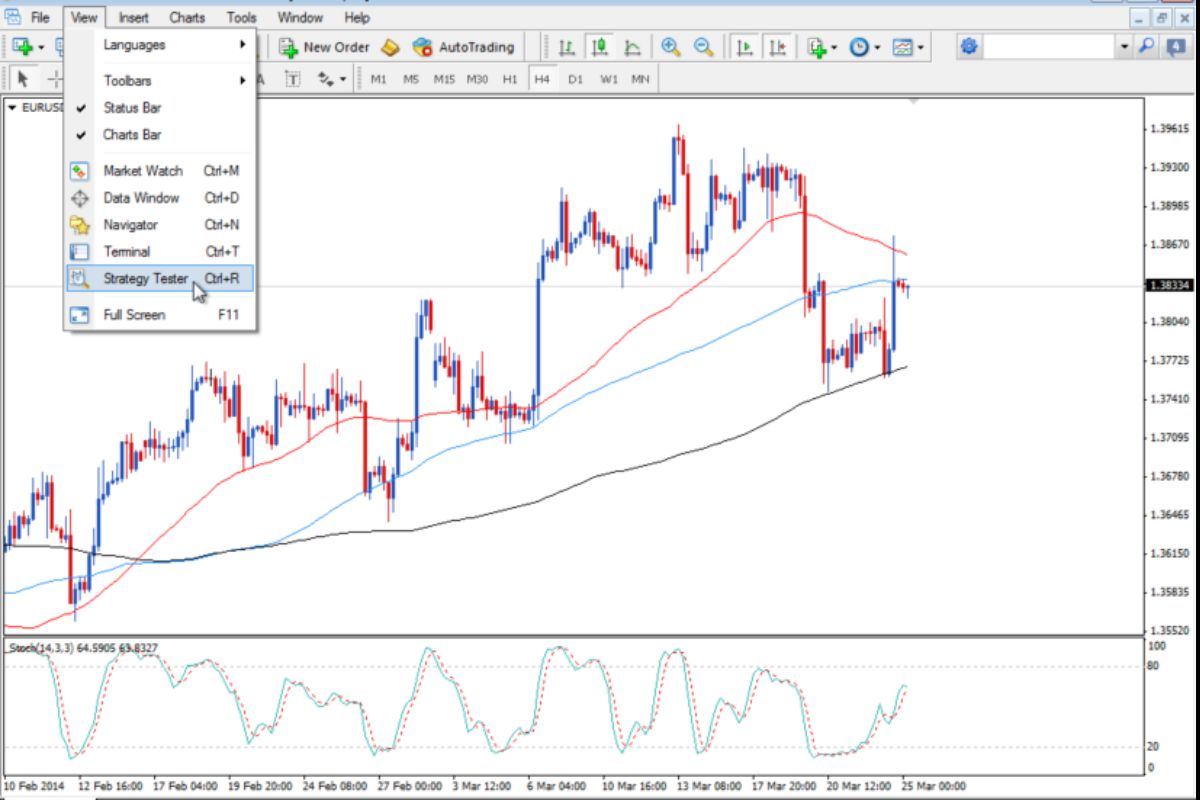
Traders can backtest an EA using historical price data to see how the strategy would have performed in the past. However, once again we must highlight that the backtest is just for reference. Traders usually expect forex robots to deliver the same results as backtests, but the actual performance is usually different because the forex market changes quickly and unpredictably.
Most robots operate on a finite rule set—trend filters, mean-reversion thresholds, ATR-based stops, or grid logic—and you will notice the difference between statistical robustness and curve-fitting in the trade record. Robust systems typically pass walk-forward tests, Monte Carlo simulations, and show consistent metrics across out-of-sample periods; a practical threshold is seeing similar expectancy and profit factor across at least 1,000 trades or two distinct multi-year samples, otherwise overfitting is likely.
How a Forex Robot Works
At its core, a forex robot follows four stages: creation, backtesting, installation, and live operation. Understanding what happens at each stage — especially why backtests almost always outperform live results — is the most important thing to know before running any EA on a real account. Slippage, spread widening during news events, and VPS latency all create gaps between paper performance and live performance that most vendors never show you.
For the complete breakdown of all four stages including execution differences, order routing, and why demo results consistently beat live results on the same strategy, see The Technical Breakdown of How Forex Robots Work.
At Oreshnik, instead of running long backtests, we chose to test the robot directly on a real trading account. Over years of working with forex robots, we’ve learned that backtests can look great on paper but don’t always prepare you for what the market will do next. Markets change, spreads widen, slippage occurs, and unexpected events hit performance in ways historical data cannot fully capture. That’s why we placed Oreshnik straight into a live account and tracked it for three full months — this real-world test gives us the most reliable picture of how the robot performs today.
Understanding Different Types of Forex Robots
Forex robots are not all the same. Each type follows a different logic, and each has its strengths and weaknesses. Knowing the main families helps you choose the one that matches your trading style and risk tolerance.
Trend-following robots are the most common. They look for markets moving in a clear direction and try to ride that trend. These robots usually make fewer trades, but each trade can last for days or even weeks. Success here depends a lot on good stop-loss rules and patience.
Mean-reversion and grid robots take the opposite view. They assume price will return to its average sooner or later, so they place trades against short-term moves. A grid system may place many small trades around a set price level. These systems can be profitable in calm, sideways markets, but they can also build up large drawdowns if a strong trend develops.
Scalping robots work at very high speed. They aim to grab just a few pips at a time, but may place dozens or even hundreds of trades per day. Because profits per trade are small, they need very low spreads and fast execution. Even tiny delays or slippage can turn a scalper from profitable to losing.
Arbitrage robots try to take advantage of price differences between brokers or markets. They often need institutional-level access, colocated servers, and very fast data feeds. For most retail traders, arbitrage is not practical because brokers move quickly to close these opportunities.
AI and machine learning robots are the newest family. Instead of following fixed rules, they use models that learn from large amounts of data to predict short-term price moves. These can be powerful, but they require constant retraining and very clean datasets. Without careful testing, they can easily pick up false patterns and fail in live trading.
| Robot Type | Description |
|---|---|
| Trend-Following | Holds trades days–weeks; 50–300 trades/year; needs robust stop management; works well on EUR/USD, AUD/USD |
| Mean-Reversion / Grid | High trade frequency; sensitive to prolonged trends; common on range-bound pairs like EUR/CHF; requires drawdown tolerance |
| Scalping | Dozens–thousands trades/day; needs ECN spreads & low latency; profit per trade small (1–5 pips); sensitive to slippage |
| Arbitrage | Latency-critical; exploits price discrepancies across venues or instruments; often institutional or colocation-dependent |
| AI / ML Models | Data-hungry (10k+ bars or hundreds of thousands of ticks); requires feature engineering, regular retraining, and strong out-of-sample tests |
For most beginners, the key takeaway is simple:
- Trend-following = slower, steadier
- Mean-reversion/grid = frequent, risk of deep drawdowns
- Scalping = fast, sensitive to costs
- Arbitrage = not for retail traders
- AI/ML = advanced, data-hungry
If you already know which type fits your trading style and want to compare specific systems side by side with verified Myfxbook data, the best forex robot for MT4 comparison covers 10 live-tracked EAs across all five types with February 2026 performance data.
Who Should Consider Using a Forex Robot?
Forex robots aren’t for everyone. They can be powerful tools, but only when used with the right expectations and account setup. Over the years, we’ve seen different types of traders approach bots in very different ways.
Take for example the busy part-time trader. Someone working a full-time job who doesn’t have hours to watch charts may rely on a simple mean-reversion bot on a $10,000 account. If configured properly, such a bot could generate around 5–7% annual returns without requiring daily attention. For this trader, the robot is more like an assistant that keeps things running while they’re away.
Then there’s the risk-tolerant experimenter. This person may open a smaller account, maybe $1,000 or $2,000, just to test high-frequency scalping bots. They know the risks are higher—drawdowns could hit 30% in a bad month—but they’re curious to see how the system behaves in real time.
On the other hand, a long-term investor with a $50,000+ account might look at trend-following bots differently. For them, the robot is not about making quick gains but about catching bigger moves, like 200–300 pips on EUR/USD over a few weeks. Even a modest 10–12% yearly return is meaningful at that account size, especially when trades are managed automatically.
And of course, there are the tech-driven traders who enjoy tweaking settings, optimizing parameters, or even building their own AI-driven bots. They may not rely on a single system, but rather test multiple bots side by side, letting data decide which strategies stay and which get cut.
In short, forex robots can serve many purposes. They’re not a shortcut to instant wealth, but depending on your profile—whether you’re time-poor, curious, capital-heavy, or tech-focused—they can play a valuable role in your overall trading approach. Before running any EA on a real account, understanding the legal boundaries matters as much as understanding the strategy. Is It Legal to Use Forex EAs? covers jurisdiction-specific rules and what broker terms actually prohibit.
Benefits and Risks of Using a Forex Robot
Automation brings real advantages — speed, consistency, and emotional discipline. Automated systems execute orders far faster than manual intervention, processing thousands of price ticks per second and placing trades in milliseconds. You gain consistency by encoding your rules into software, so position sizing, stop placement, and trade frequency follow your risk plan without emotional deviation.
But automated trading also introduces specific failure modes that manual trading doesn’t have: overfitting in backtests, VPS outages, broker API changes, and strategy degradation as market regimes shift. Technical failures introduce losses not visible in backtests — VPS outages, API changes, or corrupted data feeds can leave positions unmanaged for minutes or hours. And even a small underestimation of slippage — say 0.5 pip per round trip — can turn a thinly profitable system into a money-losing one when scaled.
Whether those trade-offs are worth it depends on your account size, risk tolerance, and monitoring capacity. Are Forex Robots Worth It? Pros and Cons of Forex EAs runs the real numbers across four capital brackets and gives a direct recommendation for each.
Where to Find Forex Robots and How to Evaluate Them
Look directly at the marketplaces built into the trading platforms you already use: MetaTrader Market (within MT4/MT5) and cTrader Automate host thousands of expert advisors that you can install and backtest instantly. MetaTrader’s Market shows seller ratings, version history, and often includes demo or live performance links; many vendors publish Myfxbook or FX Blue verification badges so you can compare real-account results rather than relying solely on screenshots.
The eight verification criteria that separate legitimate EAs from scams — including how to spot survivorship bias in Myfxbook results, what “verified” actually means, and why vendor screenshots prove nothing — are covered in Are Forex Robots Legit?
To Wrap Up
A forex robot in 2025 is an automated trading system that uses code, data, and often machine learning to place trades for you. You should view a bot as a tool that extends your capacity to monitor markets, execute strategies, and manage orders with speed and consistency that you cannot match manually.
You will also face trade-offs: greater automation can reduce emotion-driven mistakes, but it raises the need for clear rules, disciplined risk settings, and ongoing oversight. The goal isn’t to find the perfect robot — it’s to find one that matches your risk profile, survives different market conditions, and allows you to extract consistent profits before market conditions eventually change.
⚠️ Disclaimer: Trading Foreign Exchange (Forex) carries a high level of risk and may not be suitable for all investors. Past performance is never a guarantee of future results. You should only trade with capital that you can afford to lose.

Work my fulltime job as the developer and writer for Oreshnikbot.com now. Have been working on forex and forex EAs for 10 years.